Sign up for Newsletter - Blog Talk Radio ShowsShows

Showing posts with label bob and jacks writing blog. Show all posts

Monday, February 20, 2017


Please join Marsha  Casper Cook on Feb 22 at 4PM EST 3 PM CST 2PM MT 1 PM PST for a very special show about writing. This isn't about marketing, social media or politics- this is about writing and why authors need to write. Jack and Dennis are both highly educated wonderful writers who are constantly writing and putting out nothing but the best. They have learned their craft well and will be discussing how their lives have changed through writing and the importance of being the best you can be by telling a good story and making it work.
 

For more info
http://www.marshacaspercook.com
http://www.worldofinknetwork.com
http://www.jackremick.com
http://www.dennismust.com


Monday, July 15, 2013

Jack Remick does it again! Coming Soon


 FOR IMMEDIATE RELEASE:


CONTACT:
Catherine Treadgold
Publisher
Coffeetown Press
PO Box 70515
Seattle, WA 98127
206-414-7673
Catherine@CoffeetownPress.Com
CoffeetownPress.com

Coffeetown Announces the October Release of Jack Remick’s Novel about Berkeley in the 70s, The Book of Changes

Seattle, WA.— On October 15, 2013, Coffeetown Press will release The Book of Changes ($15.95, 306 pp, 6x9 Trade Paperback ISBN: 978-1-60381-186-6), by Jack Remick, a work of literary fiction that covers a tumultuous year in the life of an idealistic first-year male student enrolled at UC Berkeley in 1971.

The Book of Changes is Book Three of The California Quartet, a series of standalone novels about young men coming of age in California during the 60s and 70s. The final volume, Trio of Lost Souls, will be released by Coffeetown Press in 2014. The series began with The Deification and Valley Boy.

“I’m tempted to say this is Remick’s best work,” says Frank Araujo, Author of The Q Quest, A Perfect Orange, and The Secrets of Don Pedro Miguel of Jack’s novel Valley Boy. “The writing never lets up from the first line to the last. Ricky is the prototype Okie kid who haunted the Wasteland we know as the San Joaquin. The story is witty, tense and true.”

Of The Deification, mystery writer Robert J. Ray writes: “The language, the timing, the humor, the strong verbs, the concrete nouns, the world beneath the world–all wrapped up in one novel ...You gotta read this book!”

Of Remick’s novel, Blood (Camel Press, 2011), Wayne Gunn wrote on LambdaLiterary.org: “For an author to choose as his explicit models Camus, Genet, and de Sade ... and to earn the right to be mentioned in their company is [a goal] that perhaps Jack Remick has indeed achieved.”

“Beast” is a pure innocent with one simple goal--to become an expert on the Middle Ages. He comes to Berkeley, the Cathedral of Learning, in 1971, a time of political upheaval, hallucinogenic drugs, abundant sex, and down-and-dirty rock and roll. On his quest for meaning he hangs out with a Harley-riding dwarf, a pre-goth artists' model, a sorority girl turned nymphomaniac, and the heir to a family of French aristocrats with a bloody history dating back to before Joan of Arc. Beast soon discovers that he can’t live in the past but has to embrace the present, with its traps and land mines and the horrors of contemporary society—death by motorcycle and bad acid trips. The world is exploding, but students still go to classes, fall in love, get laid, study in libraries, win awards, even graduate. The country is on fire, and Berkeley supplies the fuel.

Says Remick: “When I went to Cal, there was no tuition. Education was free. You paid a $76.50 student fee. You paid for your books, your room and board. Anything that was left you spent on booze and motorcycles. Then Ronald Reagan was elected governor and the good times ended. The Free Speech Movement (FSM) came along and the rebellion that started in Sproul Hall grew into a firestorm of protests and death and destruction. Education took a hit, tuition blasted off, leaving only the rich and well-heeled in the classrooms. After Ronald Reagan, California was never at peace again. This novel, The Book of Changes doesn’t purport to be either a sociological thesis or a history of anything. It is a fictional record of a sort filtered through time and the consciousness of young women and men who were looking for a new definition of America, of California, of the world. We didn’t succeed.”

Jack Remick is a poet, short story writer, and novelist. Blood, A Novel was published by Camel Press in 2011. The Deification, Valley Boy, and Gabriela and the Widow are all available from Coffeetown Press. Coming in 2014: a collection of poems, Sartori. You can find Jack online at www.jackremick.com.

The Book of Changes can currently be preordered on Amazon.com. After October 15th, it will be available in eBook and 6x9 trade paperback editions on BN.com, the European Amazons and Amazon Japan. Wholesale orders can be placed through info@coffeetownpress.com or Ingram. Libraries can also purchase books through Follett Library Resources or Midwest Library Service.


the finest fiction and nonfiction since 2005.

ABOUT Coffeetown Press—Based in Seattle, Washington, Coffeetown Press has been publishing– END –

Saturday, February 9, 2013

Writing Women’s Lit from a Man’s POV -Jack Remick does it well!

Saturday, February 9, 2013

The Joy of Writing Women’s Lit from a Man’s POV

Listen to this article. Powered by Odiogo.com
Gabriela and The Widow is the third novel I’ve written with women protagonists. Early on, I worked out a post-apocalyptic novel called Citadel and later I came up with Lemon Custard. I got some static about Lemon Custard for not pulling a Nora Helmer (from A Doll’s House) and turning Olive, my protagonist, into some kind of liberation heroine. But Olive is a regular woman with kids trying to find a way to make it when the odds roll against her. Gabriela is a different kind of woman. She’s been hurt, displaced, damaged. Writing from her POV was a challenge.
I think that men are uneasy writing in a woman’s voice but I find it provoking and rewarding. The challenges are enormous because we’re always bugged by the limiting specter of American Realism in the literary novel: Write what you know. If you haven’t lived it, you can’t write about it.

This tells us that because I’m not a woman I can’t write either for women or about women. Realism is a trap I won’t fall into even when I get the question that drives me nuts: Did this really happen?
Look at me—I’m six feet tall, weigh 190, wear cowboy boots and ride a Harley. Do I look like a 19 year old Mexican woman? No, it didn’t happen to me and it’s not based on a “True Story”. This is fiction. I love to create good women who stand toe to toe with good men. Reality belongs in a memoir. In fiction, it’s about emotion.
Fear, Love, Anger, Grief, Joy, Surprise. If you want to write human characters and bring down everything we are onto the written page, and if you want to reach into the minds and senses of readers, you give the reader what the characters feel and project. Men feel fear. Women show surprise. Women get angry, men do too. We all have the same emotions. In writing, it’s reaction that gives you character and character has nothing to do with gender.

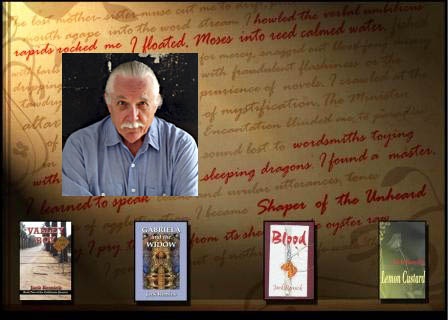
Jack Remick and books
Some Techniques and Tips:
Follow this url for more: Writing Tips for the Committed Novelist
I want to share with you a few words about how I write. Every Tuesday and Friday, I sit down with a bunch of writers at Louisa’s Bakery Café in Seattle. We write for forty-five minutes under the clock. For years I wrote alone until Robert Ray introduced me to Natalie Goldberg and timed writing. Working with other writers—especially writers who know more than you do—gets you outside your head. You get feedback faster, you get to the rewrite quicker. The way I see it, the art is in the rewrite so the sooner you get a working draft the better you’ll write. With timed writing you don’t die in Act Two.

Timed writing—what Natalie Goldberg calls “Writing Practice”—is either the devil’s design to stifle your creativity or the gateway to a paradise of writing. For me, timed writing is liberation. Timed writing is easy: you get a kitchen timer, set it for five, ten, fifteen minutes and write as deep and rich as your hand will let you. I like the physical connection of the fountain pen on paper, so I write longhand. Some writers at Louisa’s write on laptops. That’s okay. The idea is to finish what you start—that’s the major discipline. Finish what you start.

I use “start lines” to get going. If I’m working on a novel, I might use—“Today I rewrite the scene called…

If I’m with my group at Louisa’s and I’m not locked into a novel or a story, the start line “today I’m writing about…” gives me plenty of room to explode. I use timed writing to write treatments, scene summaries, memoir moments, short stories, screenplay scenes. The big thing with timed writing is that you can use it to go nuts on the page, or you can use it in a very structured way to create tight, hard, clear, clean sentences, scenes, stories. I don’t think in terms of paragraphs, but I do think in terms of “action” and “image.” When I’m writing in a more structured way, I use a directed set of start lines. For instance, to write a three-act treatment for a novel here’s a set of start lines you can use:
  • Act One opens when….
  • Act One ends when….
  • Act Two opens in a scene called….
  • At the middle of my story, my protagonist….
  • Act Two ends when….
  • Act Three opens when….
  • My story climaxes in a scene called….
  • My story ends with this final image….
I keep a blog with Robert J Ray, author of the Matt Murdock detective novels. We’ve posted everything we know about writing there—http://bobandjackswritingblog.com. Take a look. It’s there for the asking.

Guest post by Jack Remick, a poet, short story writer and novelist. In 2012, Coffeetown Press published the first two volumes of Jack’s California Quartet series, The Deification and Valley Boy. The final two volumes will be released in 2013: The Book of Changes and Trio of Lost Souls. Blood, A Novel was published by Camel Press, an imprint of Coffeetown Press, in 2011. You can find Jack online at http://jackremick.com

You can find out more about Jack Remick, his books and World of Ink Author/Book Tour at http://tinyurl.com/akw7kk6


Tuesday, January 29, 2013

Jack Remick - Gabriela and The Widow


TITLE: Gabriela and The Widow
AUTHOR: Jack Remick
PUBLISHER: Coffeetown Press  http://www.coffeetownpress.com
FORMATS: Paperback, Kindle
PAGES: 280
PRICE: Paperback - $14.95, Kindle - $6.95
FILE SIZE: 698 KB
ISBN – 10: 1603811478
ISBN – 13: 9781603811477
ASIN: B00AYQ5582

Gabriela and The Widow is a different story about growing up. It’s about Gabriela, whose village is raided and loses her mother when she’s just thirteen years old. She has no family left due to this brutal massacre. Who will help her grow into a woman?
After the massacre, Gabriela’s journey through life begins. Walking to the nearest village, her mother dies in the Mexican jungle. Gabriela has to bury her along the side of the footpath, and then continues on the arduous journey. When she arrives, she finds herself a LaPatrona and is nothing more than a slave. The LaPatrona makes a deal with the Scarfaced Man to sell her for sex. Somehow, Gabriela escapes this but her fate in life seems to get worse and worse…until she starts to work for The Widow.

The Widow is a dying ninety – two year old woman named La Viuda and Gabriela is her caretaker. Not only does Gabriela do all the cooking, cleaning and the personal care for La Viuda, she works daily with La Viuda on The List. But La Viuda is kind to her. Something that Gabriela hasn’t known since her parents were alive.

The List is a fascinating journey through La Viuda’s life and she wants it written up before her death. Day after day, Gabriela compiles boxes of slips of paper, photographs, coins, letters and more. She listens to La Viuda’s stories about each object and writes the story down. Slowly, Gabriela gets the list written in proper order. In the process, La Viuda teaches her to be a woman and soon the two are one.
This recently published book (January 15, 2013) fascinated me with all the detail written in the book. The seamless mixing of Spanish and English helped bring this young adult book to life! Even though Gabriela and The Widow starts when Gabriela is thirteen years old, I wouldn’t recommend this book for that age since the real story starts when she’s nineteen years old.

You can find out more about the author, Jack Remick, and Gabriela and The Widow at his website at http://www.jackremick.com. Mr. Remick also has a Facebook fanpage at http://www.facebook.com/pages/Jack-Remick/229527143752712?bookmark_t=page.

If you’d like to order your own copy of this tale of Gabriela and The Widow you can find it on http://www.amazon.com. You can also purchase this book on the publisher’s website at http://www.coffeetownpress.com. Get your copy today!


DRAWING!!!!
If you would like a free copy of Gabriela and The Widow for your library, just leave a comment and contact me at sasha1119 AT yahoo DOT com.
I’ll throw everyone’s name who contacts me into a hat for a drawing of the free copy. Then I’ll contact you for your mailing address so I can mail Gabriela and The Widow out to you immediately!

Wednesday, January 9, 2013


Spotlight: Author Jack Remick Shares His Writing World

VS Grenier
Jack Remick is a poet, short story writer and novelist. In 2012, Coffeetown Press published the first two volumes of Remick´s California Quartet series, The Deification and Valley Boy. The final two volumes will be released in 2013: The Book of Changes and Trio of Lost Souls. Blood, A Novel was published by Camel Press, an imprint of Coffeetown Press, in 2011.

Remick gives four people credit in helping to shape his writing world: Jack Moodey, Thom Gunn, Robert J. Ray, and Natalie Goldberg. "As a naïve and very young poet, I met Jack Moodey. Of course, being young and stupid, I knew everything so in a discussion with Jack about poetry; I asked him if he had ever written an epic poem. His reply: Six lines or eight? BAM. First idea that this might be harder than I imagined. Then I met Thom Gunn who was teaching poetry at Berkeley. He called me in one day to talk about my latest poetic effort. I remember his words exactly: Jack, if you live in another man´s universe, it will be smaller than the one you create for yourself. Second BAM. Lesson? Don´t imitate your predecessors, create your own world. Later, I met Robert J Ray, the mystery novelist and intellectual mentor to generations. Bob led me to ´timed writing´ also called ´writing practice´ or writing under the clock to free yourself from the internal editor. Third BAM. There´s an internal editor? Get that guy out of the way. Without Bob, there are no novels in my life. Then, Taos. Natalie Goldberg and the Zen of Writing. In Taos, I listened to Natalie say: Writing gets more writing. You walk in the mist you get wet. Writing connects mind to mind. Finish what you start. Shut out the noise. Fourth BAM. No such thing as writer´s block, put pen to paper, it´s okay to write memoir. All writing is in the body. The body is the focus and the be-all and end-all of writing. You want to click into the viscera of being alive, shut out the noise, listen to the whispers of time and let them guide your pen," shared Remick.

In Remick´s writing life, the writing has always been more important than the publishing. He was published, as a poet, very early and realized that unless he had a body of work he was useless as a writer so Remick kicked back, found the discipline he needed and kept on writing.

"Jack Moodey told me that he got one acceptance for every 300 submissions," commented Remick. The early success told him he could do it. Remick also learned that unless he had the discipline, he would not be a writer but someone who had written a book. "I have seen many ´sophomore or second book´ failures because the writers blasted out that first novel on guts and adrenaline, but didn´t have the discipline to know how to do the second book. Roland Barthes breaks us up into two categories—ecrivains and ecrivants. The one writes, the other writes things," said Remick. "My experience has taught me this—you´re not writing a novel, you´re writing a dramatic scene. Each scene hooks to another scene. Scenes link together in plot tracks. Plot tracks are built on objects, characters, actions or symbols. This process is an integrated one that starts with—the scene and its parts. I´ve put all of this information on the blog I keep with Robert J. Ray: http://bobandjackswritingblog.com."

Remick writes by hand on yellowed lined paper. He sets a timer and writes until the timer goes off. His discipline is this—finish what you start. Honor your words. Type up what you write. And, the most important thing—work with other writers. Force yourself to put pages on the table. Listen to what your readers tell you.

"I have a disciplined approach to this—everything starts in a state of absolute chaos and I dabble at the writing until either a character or a story emerges, one with enough zing to make me want to know more. I spend a lot of time ´writing about the writing´ which means getting to know the Story, then working out a Structure, then, towards the end, paying attention to Style. Story begets Structure, Structure begets Style. Style is language honed into smooth blocks or rough cut hunks of emotion and energy," shared Remick.

Remick is currently touring his recently released novel Gabriela and The Widow, a very personal novel not at all based on personal experience. It is a novel about two women, one dying—The Widow; the other—Gabriela, is blossoming. It is an archetypal Mother-Daughter novel working the idea that culture passes through women. It is built on the notion that our memory is fallible and that our stories have to be written down for them to be meaningful. It is a novel about the transformative power of love and respect. It is also a novel built on the idea that women share deep and universal secrets regardless of which culture they live in.

Remick shared his thoughts on the novel, "I wrote Gabriela and The Widow because I needed a novel about immigrants coming to America—and we´ve been coming here for fifteen thousand years. I wanted to focus on the latest leg of that Diaspora—the one from South to North, to El Norte. I wanted to write about the collision of cultures and to show how, in the end, we are connected and I wanted to write about the women. The men in Gabriela and The Widow are incidental--they are punishing, they are brutal, they are cheats and liars--but this is not a misanthropic book. Rather, it´s the story of how The Widow makes Gabriela in her own image. In a sense, it is a novel about women for women and it is a novel about women before men. It always struck me as odd that writing was invented only three times—that we know of—Mesopotamia, China, and Mesoamerica. So what in the mind of Mesoamerica spurred that epic of creation? I think Gabriela shows us some of the energy of that mind."

However, Remick has written a broad range of books from book-length poems such as Josie Delgado to the non-fiction The Weekend Novelist Writes a Mystery. "Right now I´m completing The California Quartet, all literary fiction. Blood is on a shelf by itself because I´m not sure just what it is so I keep it in a glass case apart from the other work," said Remick.

The World of Ink Network will be touring author Jack Remick´s contemporary women´s literary novel, Gabriela and The Widow published by Coffeetown Press throughout January and February 2013. ISBN: 978-1-60381-147-7 Publication Date: January 15, 2013

Gabriela and The Widow is currently available for pre-order on Amazon.com. After January 15, 2013, it will also be available in multiple eBook and 6x9 trade paperback editions on BN.com, the European Amazons and Amazon Japan.

Wholesale orders can be placed through info@coffeetownpress.com Baker & Taylor or Ingram. Libraries can also purchase books through Follett Library Resources or Midwest Library Service.

Gabriela and The Widow is the story of Gabriela, a 19 year old Mexican woman who migrates north (to El Norte) where she meets a dying 92 year old woman, The Widow. The novel is their story.

You can find out more about Jack Remick, his books and World of Ink Author/Book Tour at http://tinyurl.com/akw7kk6

Follow Jack Remick at

Author page: http://jackremick.com

Blog: http://bobandjackswritingblog.com

Twitter: @jackremick

VS Grenier

VS Grenier is an award-winning children's author, founder & owner of Stories for Children Publishing, LLC., award-winning editor-in-chief of Stories for Children Magazine and chief editor for Halo Publishing, Int, and also, the host of the blog talk radio shows Stories for Children, Families Matter, What is Success and The Writing Mama. A California girl at heart and former fashion buyer, Grenier lives in Southern Utah with her supportive husband, their three children and the family's minature schnauzer Taz

Saturday, October 27, 2012

Tips for Surviving The NaNoWriMo - Robert Ray -


  • Tips for Surviving NaNoWriMo. Okay. 50,000 words in 30 days. You’ve done the math, over 1600 words every day. You’re writing fast, feeling the buzz, feeling the worldwide wave – half a million hungry writers, maybe more, pounding those keys.
  •  
  • Tip One:
  •  Beating the numbers game by writing Scenes
    using *Timed Writing*. Using the *scene template*, write 3 scenes a day at
    33 minutes per scene. In 33 minutes you’ll write from 1000 to 1200 words.
    Per day, that’s 3000 to 3600 words. For NaNoWriMo, you’ll produce more than 50,000 words.
  •  
  •   Tip Two:
  • As you write your three scenes a day, make two
    lists: (1) a character list and (2) an object list. The character list
    clues you to subplots and character arcs. In fiction and film, a characterArc has four attributes: Entry, Exit, Fate, and *Core Story*. The object list locks you into action – holding the pistol with both hands, Martha shot the intruder – blood splashed from his heart – and repeating a key object holds hold the novel together. When you hammer out your 50,000 words, you use the lists to guide your rewrite.
  • Tip Three:
  • Get to the end
    fast. Skip scenes if you need to. Make a note – Rainbow Shirt scene goes here – and gallop to the end. Then you can loop back for your second run. Getting to the end will keep your story from sagging in the middle.
  •  
  • Tip Four:
  •  Rewrite the climax. Ingredients: Your protagonist, the one who leads.
    You antagonist, the one who blocks the way. For each character, you need motive: what are they doing here? What do they want and why? What’s
    stopping them? And you need an object – one that you unearthed from your boiling brain way back there in Act One. The objects – Hand over the treasure. Not on your life, dude – sharpen the action.
  •  
  • Tip Five:
  • Pace your drama with Key Scenes: Page One and After, Plot Point One, Midpoint, Etc.
    For a full analysis of Key Scenes, check Rewriting Key Scenes in The

  • Weekend Novelist Rewrites the Novel<http://www.amazon.com/Weekend-Novelist-Rewrites-Novel-Step/dp/0823084434/ref=sr_1_1?ie=UTF8&s=books&qid=1288404875&sr=1-1>. Tip
  •  
  • Six: If your NaNo Novel is a mystery, start with the killer – not the sleuth – and then bring the sleuth onstage for the First Encounter, the
    only Key Scene that is movable. For help in depth, see our handy book, The Weekend Novelist Writes a Mystery<http://www.amazon.com/s/ref=nb_sb_ss_i_1_37?url=search-alias%3Dstripbooks&field-keywords=the+weekend+novelist+writes+a+mystery&x=0&y=0&sprefix=the+weekend+novelist+writes+a+mystery> .
  •  
Have fun with syntactic explorations. Forget proper grammar and
go for style. Here’s how: First, write a passel of short sentences. See
Spot run. See Jane fall. Second, follow the short sentences with chaining.
Fall down Jane and grab Spot by the tail. Tail of the dog pulls Jane
through the wet grass. Grass on Jane’s knees and….Third, follow the
chaining with the Long Sentence Release: Trapped in the red wagon, Dude
watched his sister Jane run after the dog calling Spot come back Spot come
back her white knees flashing under the skirt tripping on a rock up through
the air a loop coming to rest at the feet of the intruder a grim-faced man with…. *